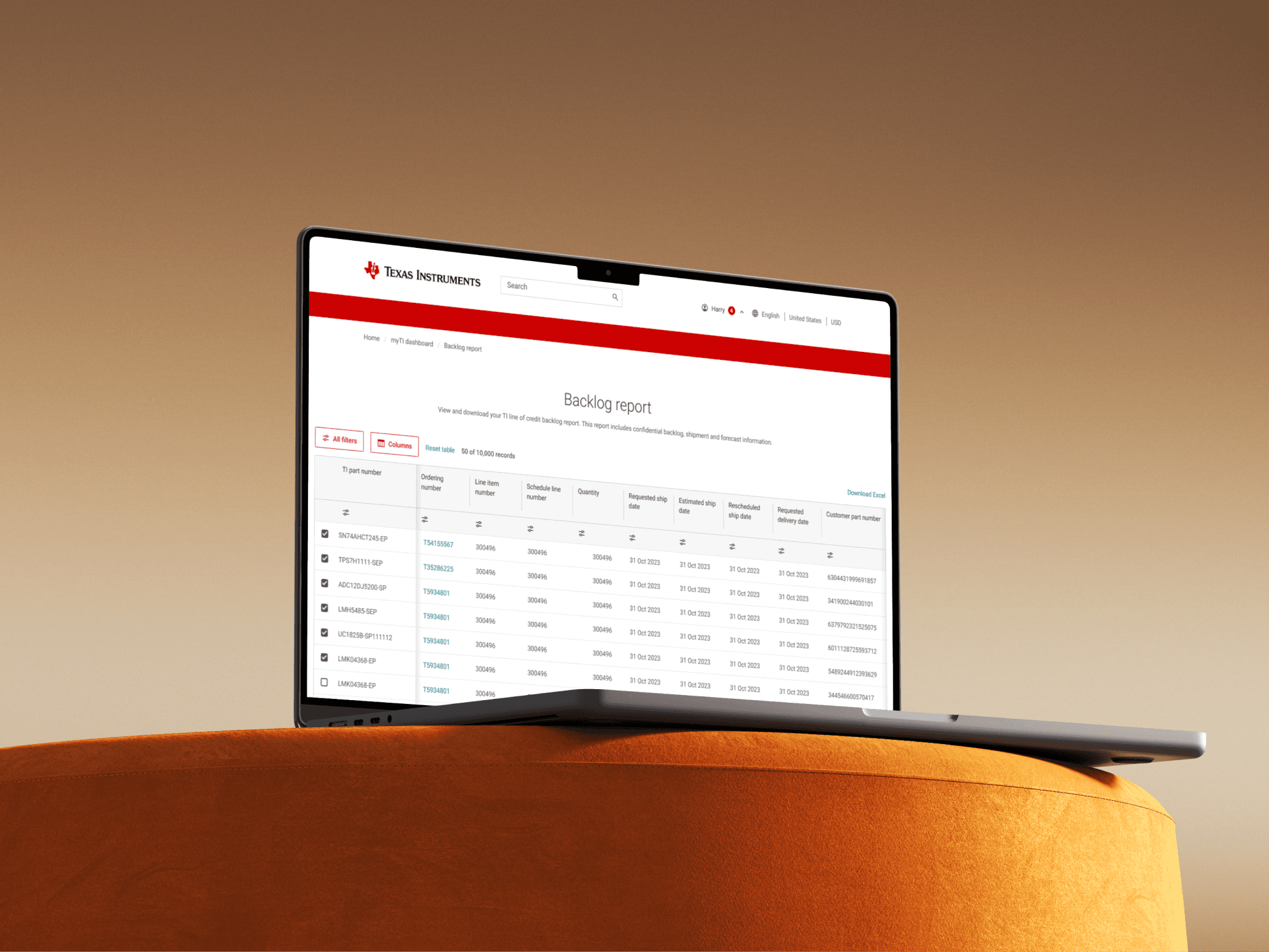
Backlog report self-service
Backlog report
self-service

Over 150,000 Customer service center tickets are generated annually by backlog customers who need access to their backlog, shipment, and invoice information.
Over 150,000 Customer service center tickets are generated annually by backlog customers who need access to their backlog, shipment, and invoice information.
Project Description
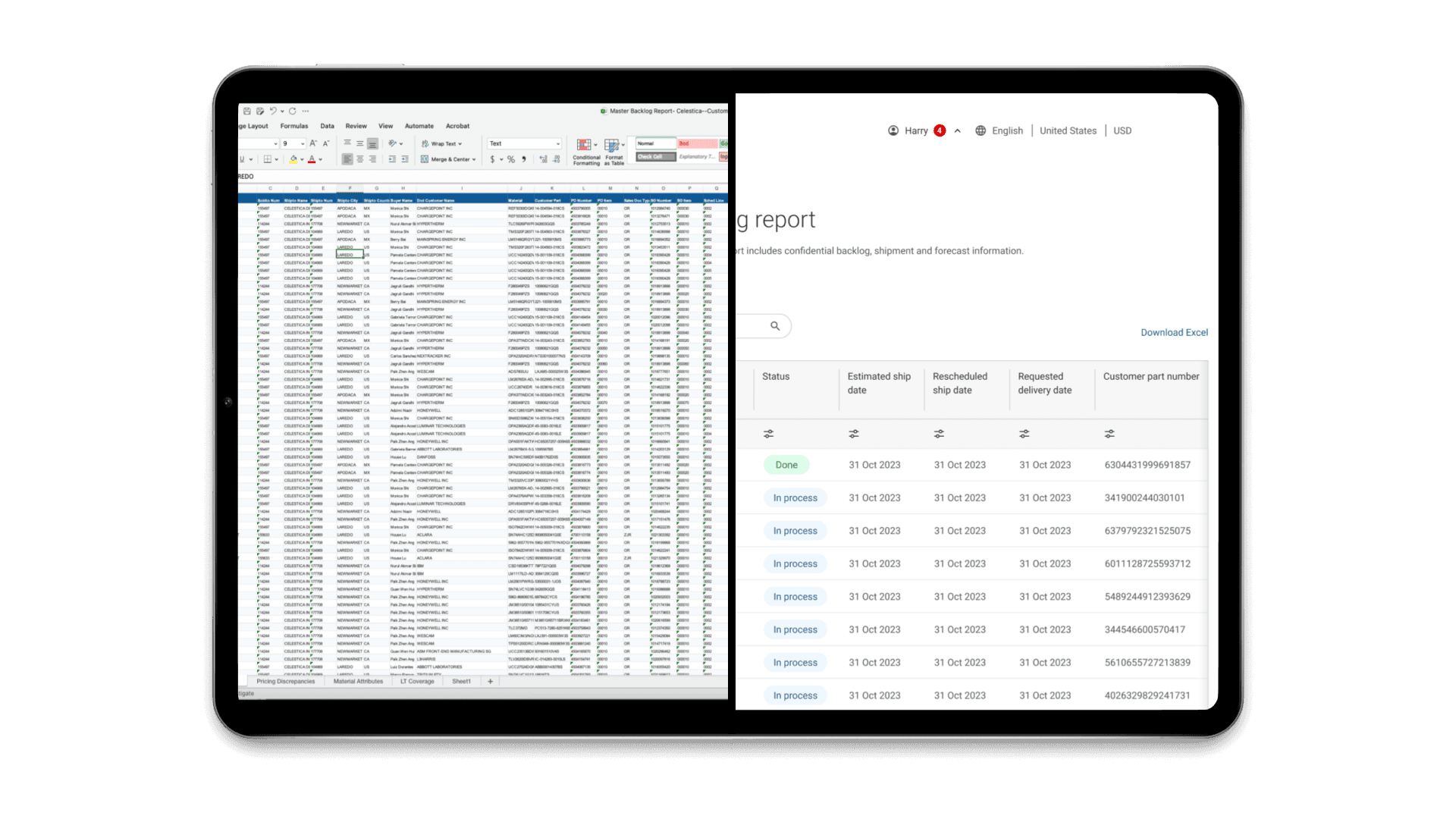
The backlog report system is an enterprise solution designed to manage extensive shipping information between buyers and suppliers. In the semiconductor industry, we handle part numbers, statuses, requested delivery dates, and company names, encompassing 36 columns of information. Prior to the establishment of the backlog report system, Texas Instruments managed backlog tickets requested by customers, generating 150,000 tickets per month through the customer service department manually. To alleviate this significant workload, we opted to create a backlog report system that allows customers to monitor their large orders and subscribe to automatically sent reports independently.
Image. Excel and online table comparison
Project Description
The backlog report system is an enterprise solution designed to manage extensive shipping information between buyers and suppliers. In the semiconductor industry, we handle part numbers, statuses, requested delivery dates, and company names, encompassing 36 columns of information. Prior to the establishment of the backlog report system, Texas Instruments managed backlog tickets requested by customers, generating 150,000 tickets per month through the customer service department manually. To alleviate this significant workload, we opted to create a backlog report system that allows customers to monitor their large orders and subscribe to automatically sent reports independently.
Image. Excel and online table comparison
Retrospective
As a UX/UI Designer leading the Backlog Report system from 0 to 1, I transformed a previously fragmented and inefficient reporting experience into a structured, user-centered platform. The project focused on identifying critical pain points, simplifying complex workflows, and creating a more intuitive information architecture that improved clarity and usability across the system.
Through thoughtful UX strategy, clear categorization, logical task flows, and accessible interaction patterns, the redesigned experience streamlined how users submitted, tracked, and managed backlog reports. Feedback mechanisms and clearer communication touchpoints were also introduced to strengthen transparency between teams and reduce operational friction.
The outcome was a scalable and user-friendly reporting system that minimized confusion, reduced reporting errors, and significantly improved overall workflow efficiency and internal collaboration.
What I have learnt.
I developed a more profound comprehension of the significance of prioritizing the needs and challenges faced by users. Additionally, I gained insight into how enterprises manage logistical knowledge from the business to the customers (B2B & B2C). By concentrating on simplifying intricate tasks, I discovered how to design intuitive solutions that improve overall workflow efficiency.
I recognized the value of an iterative design process. By engaging in ongoing testing and soliciting feedback, I was able to enhance the system to tackle user difficulties and guarantee that the final product aligned with their expectations.
Thanks for browsing!
Retrospective
As a UX/UI Designer leading the Backlog Report system from 0 to 1, I transformed a previously fragmented and inefficient reporting experience into a structured, user-centered platform. The project focused on identifying critical pain points, simplifying complex workflows, and creating a more intuitive information architecture that improved clarity and usability across the system.
Through thoughtful UX strategy, clear categorization, logical task flows, and accessible interaction patterns, the redesigned experience streamlined how users submitted, tracked, and managed backlog reports. Feedback mechanisms and clearer communication touchpoints were also introduced to strengthen transparency between teams and reduce operational friction.
The outcome was a scalable and user-friendly reporting system that minimized confusion, reduced reporting errors, and significantly improved overall workflow efficiency and internal collaboration.
What I have learnt.
I developed a more profound comprehension of the significance of prioritizing the needs and challenges faced by users. Additionally, I gained insight into how enterprises manage logistical knowledge from the business to the customers (B2B & B2C). By concentrating on simplifying intricate tasks, I discovered how to design intuitive solutions that improve overall workflow efficiency.
I recognized the value of an iterative design process. By engaging in ongoing testing and soliciting feedback, I was able to enhance the system to tackle user difficulties and guarantee that the final product aligned with their expectations.
Please feel free to contact me for more prject details → audreykuu@gmail.com
Project Description
The backlog report system is an enterprise solution designed to manage extensive shipping information between buyers and suppliers. In the semiconductor industry, we handle part numbers, statuses, requested delivery dates, and company names, encompassing 36 columns of information. Prior to the establishment of the backlog report system, Texas Instruments managed backlog tickets requested by customers, generating 150,000 tickets per month through the customer service department manually. To alleviate this significant workload, we opted to create a backlog report system that allows customers to monitor their large orders and subscribe to automatically sent reports independently.
Retrospective
As a UX/UI Designer leading the Backlog Report system from 0 to 1, I transformed a previously fragmented and inefficient reporting experience into a structured, user-centered platform. The project focused on identifying critical pain points, simplifying complex workflows, and creating a more intuitive information architecture that improved clarity and usability across the system.
Through thoughtful UX strategy, clear categorization, logical task flows, and accessible interaction patterns, the redesigned experience streamlined how users submitted, tracked, and managed backlog reports. Feedback mechanisms and clearer communication touchpoints were also introduced to strengthen transparency between teams and reduce operational friction.
The outcome was a scalable and user-friendly reporting system that minimized confusion, reduced reporting errors, and significantly improved overall workflow efficiency and internal collaboration.
What I have learnt.
I developed a more profound comprehension of the significance of prioritizing the needs and challenges faced by users. Additionally, I gained insight into how enterprises manage logistical knowledge from the business to the customers (B2B & B2C). By concentrating on simplifying intricate tasks, I discovered how to design intuitive solutions that improve overall workflow efficiency.
I recognized the value of an iterative design process. By engaging in ongoing testing and soliciting feedback, I was able to enhance the system to tackle user difficulties and guarantee that the final product aligned with their expectations.